

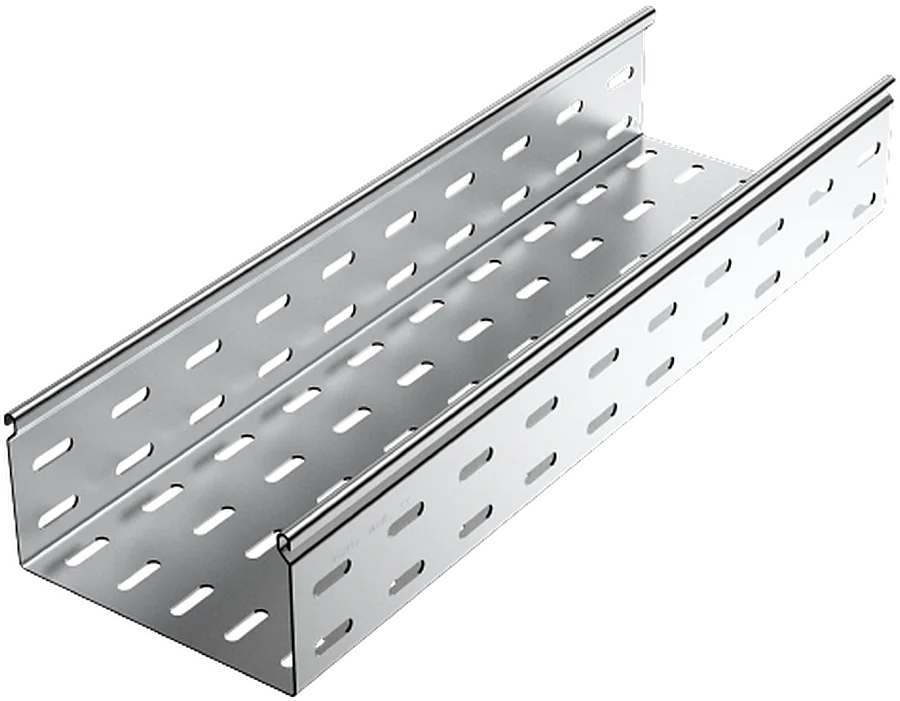
In Indian BOQs a “GI cable tray” is a tray formed from steel sheet that was galvanised at the mill, in the coil, before it was cut and punched. The same finish is written as pre-galvanised, PG or “GI sheet”. It is not the same as a hot-dip galvanised (HDG) tray, which is dipped in zinc after fabrication. The two are often mixed up in enquiries, and the difference in zinc, in life outdoors and in price is real.
GSM: how much zinc is on a GI cable tray
GSM is the weight of zinc on one square metre of sheet, both faces added together. Divide it by two and by the density of zinc (7.14 g/cm³) and you have the coating thickness on each face.
| Coating | Zinc on each face | Typical use |
|---|---|---|
| 80 GSM | about 6 µm | Dry, air-conditioned interiors |
| 120 GSM | about 8 µm | General indoor trays in buildings, electrical rooms and plant rooms |
| 200 GSM | about 14 µm | Indoor areas where the specification asks for a heavier coat |
| 275 GSM | about 19–20 µm | Specifications that name 275 GSM |
Whatever the GSM, a pre-galvanised tray has bare steel at every cut edge and punched slot. The zinc beside the edge protects it, which is enough indoors and not enough in rain, coastal air or wash-down areas. For those, specify hot-dip galvanised, SS 316L or FRP.
GI vs hot-dip galvanised vs powder coated
| Finish | How it is made | Cut edges and holes | Best for |
|---|---|---|---|
| Pre-galvanised GI | Sheet galvanised in the coil before fabrication (IS 277), 80 / 120 / 200 / 275 GSM | Bare steel at cut edges and punched holes, protected only by the adjacent zinc | Dry indoor areas — buildings, offices, electrical rooms |
| Hot-dip galvanised (HDG) | Finished tray dipped in molten zinc after fabrication; thick, metallurgically bonded coat | Coated — zinc reaches edges, slots and the inside of holes | Outdoor and industrial plants, refineries, substations, pipe racks, humid plant rooms |
| Powder coated | Mild steel HR sheet (IS 1079) with a baked organic coat, any RAL colour | Covered while the coat is intact; a chip exposes steel | Indoor dry areas, colour-coded and visible runs |
For scale: 275 GSM sheet carries roughly 20 µm of zinc per face, while the hot-dip galvanised tray Pioneer had tested at an NABL-accredited laboratory averaged 95 µm. Indoors that extra zinc is not needed, which is why GI is the standard finish inside buildings.
Where GI cable trays are used
- Commercial buildings, offices, malls, hotels and hospitals — risers, ceiling voids and electrical rooms.
- IT parks and the support areas of data centres, alongside wire mesh trays in the data halls.
- HVAC plant rooms and AHU rooms that stay dry — power and control cabling to AHUs, pumps and panels.
- Factories and warehouses — indoor production halls away from process fumes and wash-down.


GI cable tray sizes and data sheet
| Tray types | Perforated, ladder, trunking / box type and raceway; covers, bends, tees, crosses, reducers and risers to match |
|---|---|
| Sheet | Pre-galvanised steel sheet to IS 277 — 80 / 120 / 200 / 275 GSM (TATA / JSW / AMNS) |
| Widths | Perforated 25, 40, 50, 75, 100, 150, 200, 250, 300, 400, 450, 500, 600 … up to 1200 mm; ladder 25, 50, 75, 100, 150, 200, 250, 300, 400, 450, 500, 600 … up to 1250 mm |
| Heights | 15, 25, 50, 75, 100, 150, 200, 250, 300 and 400 mm |
| Lengths | 2500 mm standard; 3000 mm on request |
| Sheet thickness | 1.2 mm (18 SWG), 1.6 mm (16 SWG), 2.0 mm (14 SWG), 2.5 mm (12 SWG) and 3.0 mm, as per IS 1852 |
| Usual thickness schedule | 1.6 mm for trays up to 300 mm wide, 2.0 mm for 450 mm wide and above; covers 1.6 mm |
| Hardware | Coupler plates with M8 × 15 mm electro-galvanised nuts and bolts |
| Tolerances | Length ±10 mm, width ±3 mm, height ±2 mm (IS 1852); no negative tolerance on thickness |
| Standards and tests | UL certified; IEC 61537:2023; NEMA VE 1; load tested at an NABL-accredited laboratory |
Every size is listed with its weight per metre on the sizes and weight chart.
GI cable tray price per metre
List prices in ₹ per running metre from Pioneer price list PL-2026.10, effective 24 October 2026: supply only, ex-works Pune, GST 18% extra, coupler plates and hardware included, 2.5 m lengths. Steel and zinc prices move, so the price that applies is the one on your quotation.
| GI perforated tray, width × height (mm) | 1.6 mm (16 SWG), ₹ per metre | 2.0 mm (14 SWG), ₹ per metre |
|---|---|---|
| 50 × 50 | 227 | 284 |
| 100 × 50 | 303 | 379 |
| 150 × 50 | 379 | 474 |
| 200 × 50 | 455 | 569 |
| 300 × 50 | 607 | 758 |
| 450 × 50 | 834 | 1,043 |
| 600 × 50 | 1,062 | 1,327 |
Rates are for standard pre-galvanised GI. 275 GSM sheet, 75 and 100 mm heights, ladder trays, covers and other finishes are on the cable tray price per metre page or priced on your BOQ. Each bend, tee, cross or reducer is priced at 2.5 times the per-metre rate of the tray it matches.
Specification clause for your BOQ
Copy it into your BOQ or specification and adjust; words in [brackets] are alternatives.
Indoor — pre-galvanised GI
Dry indoor areas: buildings, offices, plant rooms, electrical rooms
1. Cable trays shall be perforated type, factory fabricated from pre-galvanised steel sheet to IS 277 with a minimum zinc coating of 120 GSM [275 GSM where specified], in straight lengths of 2500 mm.
2. Sheet thickness shall be 1.6 mm for trays up to 300 mm wide and 2.0 mm for trays 450 mm wide and above [or as per the cable tray schedule], with dimensional tolerances as per IS 1852.
3. Tray width and height shall be as per the cable tray schedule; standard height 50 mm [75 / 100 mm where scheduled].
4. Bends, tees, crosses, reducers and risers shall be factory made from the same material and thickness as the straight tray, with an inside radius to suit the largest cable.
5. Trays shall be joined with coupler plates and M8 electro-galvanised nuts and bolts so that the run is mechanically and electrically continuous.
6. Covers, where scheduled, shall be of the same material, 1.6 mm thick.
7. Trays shall be tested to IEC 61537 [NEMA VE 1 where specified] for safe working load at the scheduled support span; load test reports from an NABL-accredited laboratory shall be submitted with the technical submittal.
8. Make: Pioneer Cable Trays or approved equivalent.
Why Pioneer
- UL certified cable trays, declared to IEC 61537:2023 and load tested for NEMA VE 1.
- Tested at an NABL-accredited laboratory — load–deflection, zinc coating, salt spray, tensile and chemical reports are published as a PDF.
- Manufacturing since 1994 at our own plant in Pirangut, Pune, which turns out up to 8,000 metres of tray a day.
- Supply across India by road from Pune, and export FOB Nhava Sheva (JNPT, Mumbai).
- Quotation within 24 hours of your BOQ, with the data sheet your consultant needs.