

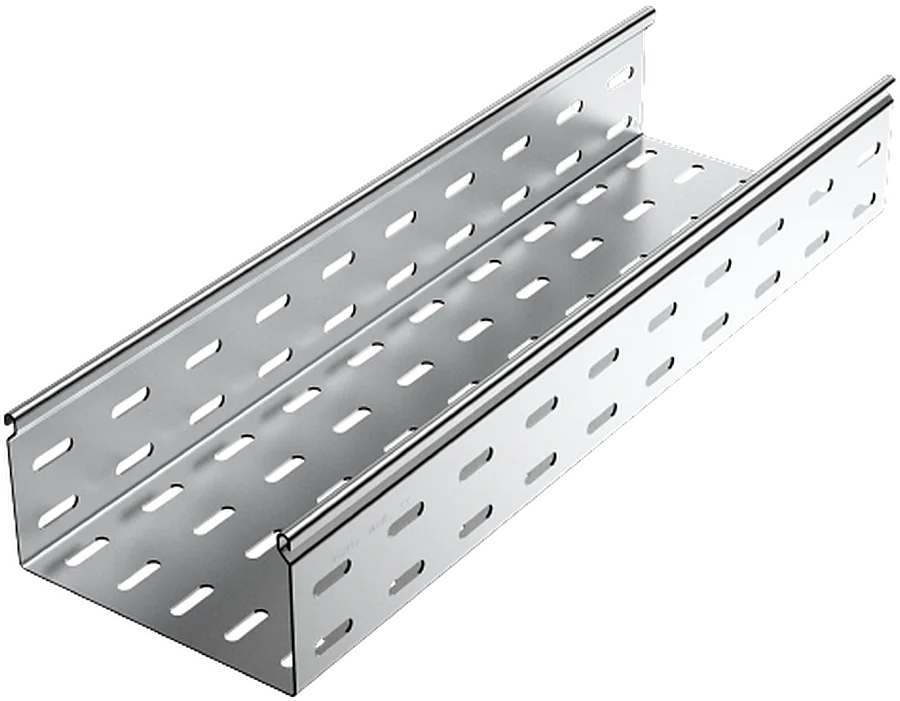
Three numbers describe a cable tray: width, height (the depth of the side) and sheet thickness, written W × H × T in millimetres. A BOQ line such as “300 × 50 × 1.6 GI perforated” means a tray 300 mm wide and 50 mm high in 1.6 mm pre-galvanised sheet.
Standard cable tray sizes
| Perforated trays — widths | 25, 40, 50, 75, 100, 150, 200, 250, 300, 400, 450, 500, 600 … up to 1200 mm |
|---|---|
| Ladder trays — widths | 25, 50, 75, 100, 150, 200, 250, 300, 400, 450, 500, 600 … up to 1250 mm |
| Trunking, box type and raceways — widths | 25, 50, 75, 100, 150, 200, 250, 300, 400, 450, 500, 600 … up to 1250 mm |
| Wire mesh trays — widths | 50 to 600 mm; 50 to 150 mm high; 3 to 6 mm wire |
| Heights (perforated, ladder, trunking) | 15, 25, 50, 75, 100, 150, 200, 250, 300 and 400 mm |
| Lengths | 2500 mm standard, 3000 mm on request; wire mesh 2.5 m and 3 m |
| Sheet thickness | 1.2 mm (18 SWG), 1.6 mm (16 SWG), 2.0 mm (14 SWG), 2.5 mm (12 SWG) and 3.0 mm, as per IS 1852 |
Sizes outside these ranges are made to your drawing. The widths asked for most often are 50, 100, 150, 200, 300, 450 and 600 mm, with 50 mm high sides for perforated trays and 75 or 100 mm for ladder trays.
Thickness: SWG to mm
| Gauge (SWG) | Thickness | Where it is used |
|---|---|---|
| 18 SWG | 1.2 mm | Covers and light-duty trays |
| 16 SWG | 1.6 mm | GI perforated trays up to 300 mm wide; covers |
| 14 SWG | 2.0 mm | GI trays 450 mm wide and above; hot-dip galvanised trays up to 300 mm; ladder side rails |
| 12 SWG | 2.5 mm | Hot-dip galvanised trays 450 mm wide and above; ladder side rails for heavy runs |
| — | 3.0 mm | Heavy-duty ladder trays, long spans |
These are the schedules consultants most often write; the cable tray schedule on your project decides.
Perforated cable tray weight per metre
Theoretical weight in kg per running metre, steel, for the tray body.
| Width (mm) | 50 high, 1.6 mm | 50 high, 2.0 mm | 75 high, 2.0 mm | 100 high, 2.0 mm |
|---|---|---|---|---|
| 50 | 1.88 | 2.35 | 3.14 | 3.92 |
| 75 | 2.20 | 2.75 | 3.53 | 4.32 |
| 100 | 2.51 | 3.14 | 3.92 | 4.71 |
| 150 | 3.14 | 3.92 | 4.71 | 5.49 |
| 200 | 3.77 | 4.71 | 5.49 | 6.28 |
| 250 | 4.40 | 5.49 | 6.28 | 7.06 |
| 300 | 5.02 | 6.28 | 7.06 | 7.85 |
| 400 | 6.28 | 7.85 | 8.63 | 9.42 |
| 450 | 6.91 | 8.63 | 9.42 | 10.21 |
| 500 | 7.54 | 9.42 | 10.21 | 10.99 |
| 600 | 8.79 | 10.99 | 11.77 | 12.56 |
| 750 | 10.68 | 13.34 | 14.13 | 14.91 |
| 900 | 12.56 | 15.70 | 16.48 | 17.27 |
| 1000 | 13.82 | 17.27 | 18.05 | 18.84 |
Ladder cable tray weight per metre
Theoretical weight in kg per running metre, steel, with rungs at 250 mm centres.
| Width (mm) | 75 high, 2.0 mm | 100 high, 2.0 mm | 100 high, 2.5 mm |
|---|---|---|---|
| 100 | 4.05 | 4.84 | 6.04 |
| 150 | 4.27 | 5.06 | 6.32 |
| 200 | 4.49 | 5.28 | 6.59 |
| 300 | 4.93 | 5.71 | 7.14 |
| 450 | 5.59 | 6.37 | 7.97 |
| 600 | 6.25 | 7.03 | 8.79 |
| 750 | 6.91 | 7.69 | 9.62 |
| 900 | 7.57 | 8.35 | 10.44 |
| 1000 | 8.01 | 8.79 | 10.99 |
Cover weight per metre
| For tray width (mm) | 1.2 mm | 1.6 mm | 2.0 mm |
|---|---|---|---|
| 50 | 0.85 | 1.13 | 1.41 |
| 100 | 1.32 | 1.76 | 2.20 |
| 150 | 1.79 | 2.39 | 2.98 |
| 200 | 2.26 | 3.01 | 3.77 |
| 300 | 3.20 | 4.27 | 5.34 |
| 450 | 4.62 | 6.15 | 7.69 |
| 600 | 6.03 | 8.04 | 10.05 |
Cable tray weight calculator
Enter any size to get the weight per metre, per 2.5 m length and for the whole run.
How the weights are worked out
- Perforated, solid and trunking body: (width + 2 × height) in metres × thickness in mm × 7.85. A 300 × 50 × 1.6 tray is 0.400 × 1.6 × 7.85 = 5.02 kg per metre.
- Ladder: two side rails, each the height plus its flanges, and four rungs per metre (rungs at 250 mm centres).
- Cover: the tray width plus its two turned-down edges, × thickness × 7.85.
- Aluminium: the same sheet weighs about one third as much (density 2.7 against 7.85).
These are theoretical weights of the sheet in the tray body. They do not deduct the perforations or add the coupler plates and hardware, and hot-dip galvanising adds the weight of the zinc. Stainless steel is about 1% heavier than the figures shown. Use them for support design and transport planning; ask us for the weights of your exact BOQ and we send them with the quotation.
Tolerances
Length ±10 mm, width ±3 mm, height ±2 mm (IS 1852); no negative tolerance on thickness.