

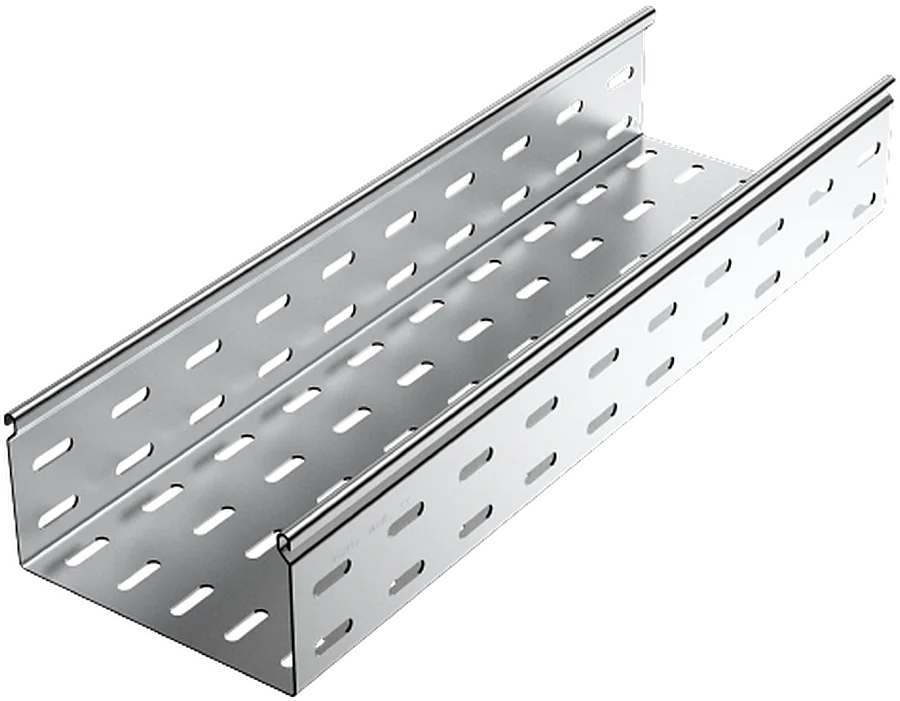
Stainless steel is the tray you specify when galvanising will not last: wash-down halls, salt air, chemical vapour. Pioneer makes the full stainless range in its own plant, so trays, fittings, covers and couplers come from one source in one grade. This page explains which grade to choose, where 316L earns its price, and what our data sheet covers.
SS 304 / 304L or SS 316 / 316L?
All four are austenitic stainless steels. The difference that matters on site is molybdenum: 316 and 316L carry about 2–3% of it, and that is what lets them resist pitting and crevice corrosion from chlorides — sea air, salt-laden dust, brine and chloride-based cleaners. The “L” grades are low-carbon versions (0.03% carbon maximum) that keep their corrosion resistance at welds.
| Grade | In brief | Choose it for |
|---|---|---|
| SS 304 | About 18% chromium, 8% nickel | Food, pharma and wet indoor areas without chloride exposure |
| SS 304L | 304 with low carbon | As 304, where fittings and supports are welded |
| SS 316 | 304 plus about 2–3% molybdenum | Coastal sites, chloride exposure, chemical areas |
| SS 316L | 316 with low carbon | Marine-facing plants, chemical and pharma process areas, welded assemblies in chloride service |
Our rule of thumb for consultants: SS 304 for food, pharma and wet areas; SS 316L for coastal and chemical environments. If the tray will see salt air or chloride cleaners, 316L costs less than replacing pitted 304.
Where SS 316L cable trays are used
- Pharmaceutical plants — process halls, solvent areas and wash-down zones (see cable trays for pharma plants and cleanrooms).
- Food, dairy and beverage processing, where trays are hosed down daily.
- Coastal plants, ports, jetties and marine-facing terminals within reach of salt spray.
- Chemical, petrochemical and fertiliser plants with chloride-bearing atmospheres; for strong acid and alkali zones compare FRP trays.
- Desalination, effluent and water treatment plants.
- Offshore-adjacent onshore facilities — oil and LNG terminals, shore bases and fabrication yards.


Stainless steel cable tray data sheet
Taken from Pioneer’s published data sheets. Anything outside these ranges we make to your drawing.
| Tray types and models | Perforated: SS304L CTP 1004, SS316L CTP 1005. Ladder: SS304L CTL 2004, SS316L CTL 2005. Wire mesh: SS304L WMCT 1006, SS316L WMCT 1007. Covered trunking in SS 304 / SS 316L on request. |
|---|---|
| Grades | SS 304, SS 304L, SS 316 and SS 316L |
| Widths | Perforated 25, 40, 50, 75, 100, 150, 200, 250, 300, 400, 450, 500, 600 … up to 1200 mm; ladder 25, 50, 75, 100, 150, 200, 250, 300, 400, 450, 500, 600 … up to 1250 mm; wire mesh 50–600 mm as standard |
| Heights | 15, 25, 50, 75, 100, 150, 200, 250, 300 and 400 mm (sheet-metal trays); wire mesh 50–150 mm |
| Lengths | 2500 mm standard; 3000 mm on request; wire mesh 2500 and 3000 mm |
| Sheet thickness | 1.2 mm (18 SWG), 1.6 mm (16 SWG), 2.0 mm (14 SWG), 2.5 mm (12 SWG) and 3.0 mm, as per IS 1852 |
| Wire mesh | 3, 4, 5 and 6 mm wire, 50 × 100 mm mesh, T-welded safety ends; SS 304 electro-polished on request |
| Hardware | M8 × 15 mm coupler bolts in SS 304 for stainless sheet-metal trays; stainless hardware of the tray grade for wire mesh |
| Tolerances | Length ±10 mm, width ±3 mm, height ±2 mm, thickness ±0.2 mm (IS 1852) |
| Standards and tests | UL certified; IEC 61537:2023; NEMA VE 1; load tested at an NABL-accredited laboratory |
| Documents | EN 10204 3.1 material test certificates per lot; data sheets and GA drawings for approval |
Specifying a stainless run that stays stainless
- Keep the whole run in one material family — tray, fittings, covers, couplers, supports and fixings. A carbon-steel bracket or zinc-plated bolt is the first thing to rust on a 316L run.
- Keep carbon-steel tools and grinding dust off stainless during erection; embedded iron particles rust and stain the surface.
- Name the grade on every BOQ line. “SS” alone usually gets priced as 304.
- Ask for the material certificate per lot and check the grade against the heat number.
Specification clause for your BOQ
For stainless wire mesh in food, dairy, pharma and coastal areas. Copy it and adjust; words in [brackets] are alternatives. Perforated and ladder clauses are on the perforated and ladder pages — change the material line to SS 316L.
Wash-down and corrosive — stainless steel
Food, dairy, pharma and coastal sites
1. Cable trays shall be welded wire mesh type in SS 304 [SS 316 for coastal and chemical areas], electro-polished where specified, 50 × 100 mm mesh with T-welded safety ends.
2. Wire diameter shall be 4.5 mm up to 200 mm wide, 5 mm at 300 mm and 6 mm at 400 and 600 mm [or as scheduled].
3. Couplers and hardware shall be stainless steel of the same grade.
4. Width and height shall be as per the schedule, in lengths of 3000 mm [2500 mm].
5. Make: Pioneer Cable Trays or approved equivalent.
Why Pioneer
A stainless tray is only as good as its paperwork. We make the trays and fittings ourselves and certify the grade lot by lot.
- UL certified cable trays, declared to IEC 61537:2023 and load tested for NEMA VE 1.
- Tested at an NABL-accredited laboratory — load–deflection, zinc coating, salt spray, tensile and chemical reports are published as a PDF.
- Manufacturing since 1994 at our own plant in Pirangut, Pune, which turns out up to 8,000 metres of tray a day.
- Supply across India by road from Pune, and export FOB Nhava Sheva (JNPT, Mumbai).
- EN 10204 3.1 material certificates for stainless steel with every lot.
- Quotation within 24 hours of your BOQ, with the data sheet your consultant needs.