

On our home page we put it in one line: aluminium is the tray for where weight and corrosion both matter. This page explains when that is true, what to watch when you specify it, and what Pioneer supplies.
Why specify aluminium cable trays
- Light. Aluminium weighs about a third as much as steel for the same volume — easier handling at height, less load on slabs, hangers and existing structures.
- Self-protecting. It forms a thin oxide film that heals itself, so there is no zinc coat to wear through and no cut edge to touch up.
- Non-magnetic. It does not heat up from the magnetic field around single-core AC power cables the way steel can — one reason it is chosen for large single-core runs.
- Clean. No rust staining on ceilings, walls or equipment below.
The trade-off is stiffness. Aluminium’s elastic modulus is about a third of steel’s, so a tray of the same section deflects more under the same load. Aluminium trays are usually specified with deeper side rails or shorter support spans than steel — which is why we size the section against your cable load and span, not from a catalogue line.
Aluminium vs HDG vs SS 316L
| Aluminium | Hot-dip galvanised steel | SS 316L | |
|---|---|---|---|
| Weight | About one third of steel | Heaviest | Similar to steel |
| Corrosion protection | Natural oxide film; no coating to damage | Zinc coat, consumed over time; cut edges need touch-up | Stainless throughout; best against chlorides |
| Stiffness for the same section | Lower — deeper rails or shorter spans | High | High |
| Magnetic | No | Yes | Essentially non-magnetic |
| Avoid in | Strong alkalis; contact with copper or bare steel in wet areas | Coastal splash zones, acid vapour | Strong acids where FRP is the better choice |
Not sure which way to go? See HDG cable trays, SS 316L cable trays and our tray type and material comparison.
Where aluminium cable trays are used
- Coastal and humid sites where rust streaks or zinc loss would be a problem.
- Rooftops, mezzanines and retrofits where the structure has little spare capacity.
- Long runs of single-core power cable.
- Clean, visible runs in commercial buildings where rust staining is unacceptable.
- Export projects whose specification calls for aluminium ladder or tray by default.


What Pioneer supplies in aluminium
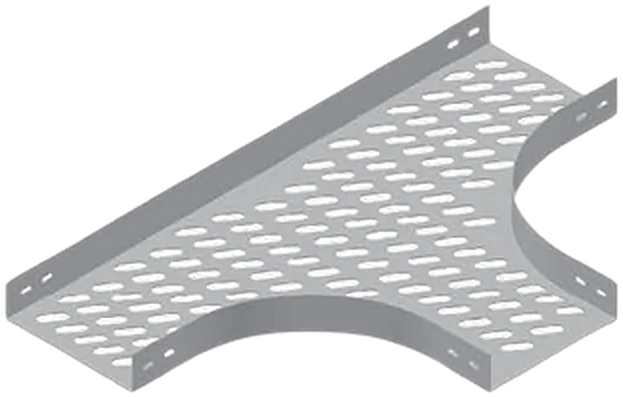
| Tray types | Perforated and ladder cable trays with bends, tees, crosses, reducers and covers; trunking / box type and raceways in aluminium on request |
|---|---|
| Aluminium grade | To your specification |
| Sheet thickness | To your specification; we confirm the section against your cable load and support span |
| Widths | Perforated 25, 40, 50, 75, 100, 150, 200, 250, 300, 400, 450, 500, 600 … up to 1200 mm; ladder 25, 50, 75, 100, 150, 200, 250, 300, 400, 450, 500, 600 … up to 1250 mm |
| Heights | 15, 25, 50, 75, 100, 150, 200, 250, 300 and 400 mm |
| Lengths | 2500 mm standard; 3000 mm on request |
| Hardware | Coupler plates with M8 × 15 mm nuts and bolts in SS 304 |
| Tolerances | Length ±10 mm, width ±3 mm, height ±2 mm, thickness ±0.2 mm (IS 1852) |
| Standards and tests | UL certified; IEC 61537:2023; NEMA VE 1 |
| Documents | EN 10204 3.1 material test certificates for aluminium, per lot; data sheets and GA drawings for approval |
What to write in your specification
- The aluminium alloy and temper, and the minimum sheet or rail thickness.
- Safe working load at your support span, with the deflection limit (IEC 61537 limits mid-span deflection to 1/100 of the span).
- Stainless steel fasteners, and isolation from copper or bare steel supports where the run is wet.
- Fittings, covers and couplers in the same alloy as the tray.
Why Pioneer
We make aluminium trays alongside our steel and stainless range, so a mixed BOQ comes from one plant with one set of drawings.
- UL certified cable trays, declared to IEC 61537:2023 and load tested for NEMA VE 1.
- Tested at an NABL-accredited laboratory — load–deflection, zinc coating, salt spray, tensile and chemical reports are published as a PDF.
- Manufacturing since 1994 at our own plant in Pirangut, Pune, which turns out up to 8,000 metres of tray a day.
- Supply across India by road from Pune, and export FOB Nhava Sheva (JNPT, Mumbai).
- EN 10204 3.1 material certificates for aluminium with every lot.
- Quotation within 24 hours of your BOQ, with the data sheet your consultant needs.